
 Forecast Interiors — Journal

A bathroom exhaust fan is rarely the part of a renovation anyone looks forward to choosing, and it is easy to leave to the last minute. Here are the decisions worth making on purpose, drawn from guidance published by the Home Ventilating Institute (HVI) and the ENERGY STAR program.
How much air does the room need?
Fan capacity is measured in CFM, short for cubic feet per minute: the volume of air the fan moves each minute.
For a bathroom up to 100 square feet, HVI recommends that an exhaust fan provide 1 CFM per square foot, which it describes as approximately eight air changes per hour. HVI's own example is a bathroom of 8 by 5 feet with 8-foot ceilings: 40 square feet, so the minimum recommendation is a fan rated at 40 CFM.
For a bathroom above 100 square feet, HVI bases the rate on the fixtures in the room rather than its size:
- Toilet: 50 CFM
- Shower: 50 CFM
- Bathtub: 50 CFM
- Jetted tub: 100 CFM
So a larger primary bath with a tub, a separate shower and a toilet adds up to 150 CFM.
One fan or several?
For that larger room, HVI describes two approaches. You can place a 50 CFM fan over the tub, one in the shower and one in the water closet, which HVI calls very effective because it ventilates where and when it is needed. Or you can install one 150 CFM fan, which pulls air through the whole room and exhausts it at a central location.
HVI also notes that an enclosed toilet room must have an operable window or a fan, and that for a steam shower it is best to have a separate fan in the steam room that can be turned on after use.
Where the fan goes
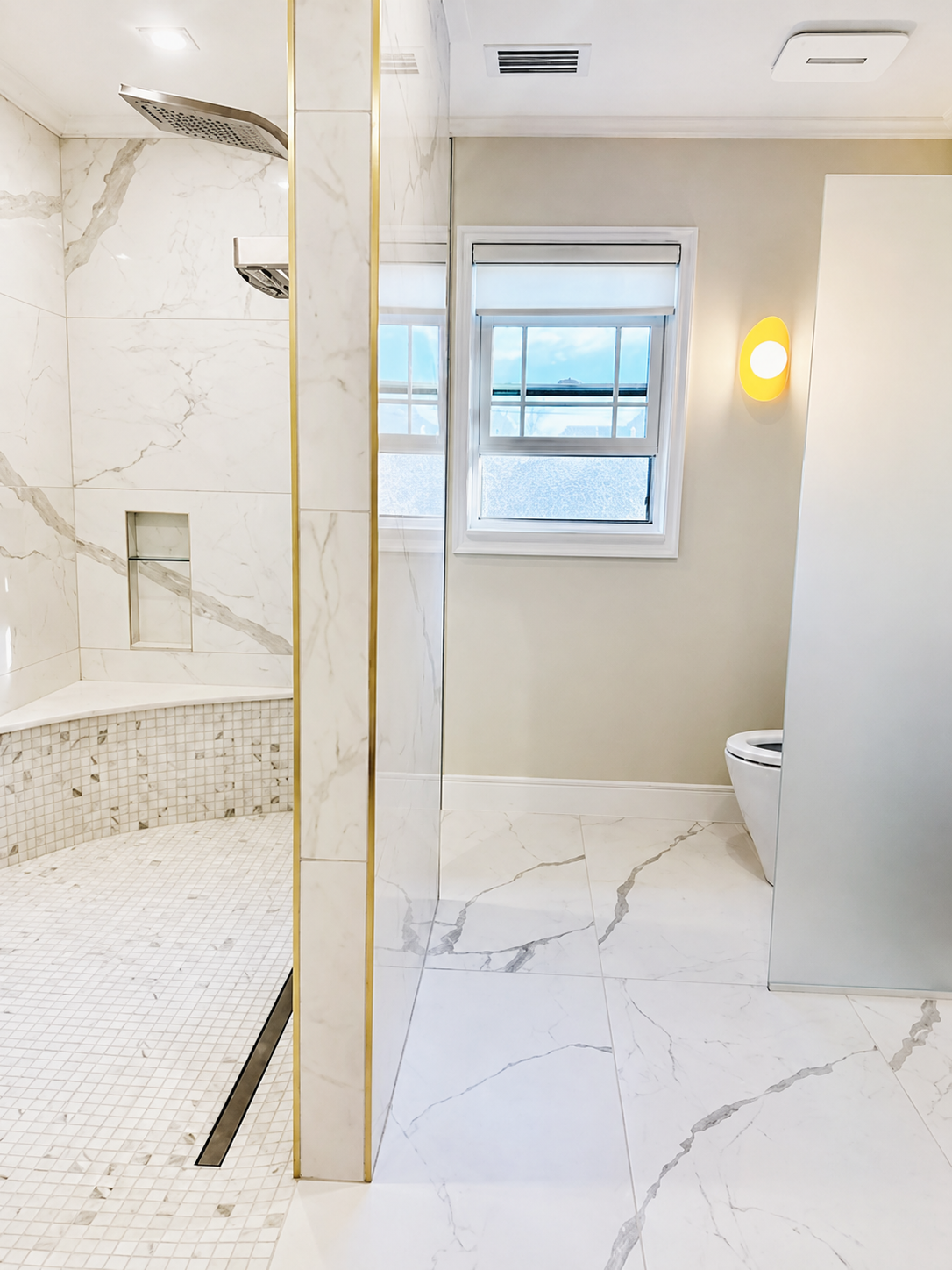
HVI says exhaust points are typically located over or near the shower or tub and in an enclosed water closet. With windows closed, the air the fan removes is replaced by makeup air from adjacent rooms or forced-air registers, so HVI recommends placing the exhaust away from the supply, which pulls that air through the room. It also notes that bathroom doors need to be undercut so that makeup air can enter.
A fan over a tub or shower is a product-by-product question. HVI's guidance is that the installation instructions will say whether a given fan may go there, and that if it is rated for that location, a ground fault interrupter is also required. Some fans may be mounted in a side wall rather than the ceiling, but HVI says to confirm that in the installation instructions or with the manufacturer.
Where the air goes
HVI is plain on this point: you cannot exhaust directly into the attic, as the practice is prohibited in building codes. HVI also explains that the most common reason for water dripping from an exhaust fan is uninsulated duct running through unconditioned space, where warm, humid air meets a cold attic and condenses.
How quiet is quiet?
Fan noise is rated in sones. HVI describes the sone as an internationally recognized unit of loudness on a linear scale, so double the sone value is double the loudness. In everyday terms, it says, one sone is equivalent to the sound of a quiet refrigerator.
Efficiency and the ENERGY STAR label
For an ENERGY STAR certified bathroom or utility room fan, the program sets a maximum sound level of 2.0 sones for fans from 10 to 200 CFM, and 3.0 sones from 201 to 500 CFM at maximum speed. It also sets minimum efficacy in CFM per watt (2.8 for 10 to 89 CFM, 3.5 for 90 to 200 CFM and 4.0 for 201 to 500 CFM), and requires a warranty of at least one year.
How long to run it
HVI recommends leaving the fan on for 20 minutes after the bathroom is used, and suggests a timer so it switches off on its own at the right time. It adds that ventilation may also be provided continuously at other rates, which may complement the use of fans at its recommended rates.
What it means for a home in Lexington
If a bathroom ceiling is being opened during a renovation, that is the natural moment to size the fan properly, plan where it sits and think about how its duct runs. There is more on planning a bath on the bathrooms page, and if a renovation is on your mind, do get in touch.